
Travis County Crime News Sources
Go to the official sources first. The Travis County Sheriff's Office Public Information Office handles press communications and routes photo requests. There is no routine searchable booking-photo feed there. Reporters can ask TCSO for a mugshot when TCSO made the arrest; another agency's arrest means that agency calls the shots on release. Everyone else goes through the standard open-records process.
Local coverage adds color, but only selectively. FOX 7 Austin reports on Austin and the surrounding county as events unfold. A story might carry a police-supplied booking photo, a different picture, or none at all. Either way, the outlet is not a custody roster, and its choices tell you nothing about who is currently behind bars. The FOX 7 Austin local-news page appears below as an example of a reporting channel, not an official booking database.
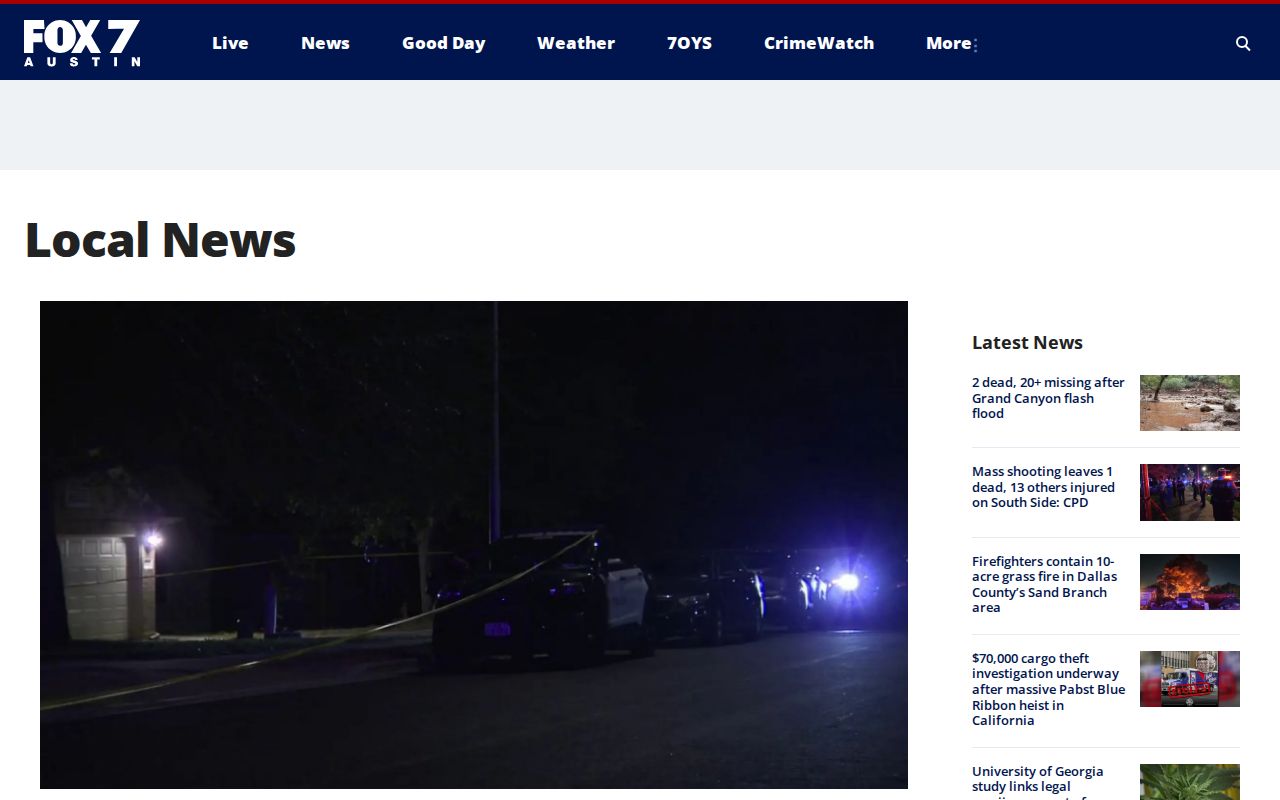
That image shows a news landing page. It is not a gallery. It is not a custody result. So treat a report as a starting point. After reading one, follow the arresting agency and the court docket. That matters most when a headline was refreshed long after the original incident.
Travis County News Outlet Details
The county's media scene spans television, daily newspapers, and independent local outlets. Each one picks its own stories. None functions as a continuous official mugshot roster. A story's publish date is not an arrest date, either, and should never stand in for one. For current custody or later court action, the official records are the only reliable source.
| Outlet or source | Coverage | Photo practice | Where to look |
|---|---|---|---|
| TCSO Public Information Office | Official sheriff communications and media routing. | Request policy depends on the arresting agency and requester type. | TCSO PIO |
| FOX 7 Austin | Local Austin and surrounding-area breaking coverage. | May use an agency-supplied booking image or another news image. | Local news |
| KVUE | Local Austin-area reporting. | Story-by-story editorial choice, not a routine photo feed. | Local news |
| KXAN | Austin local-news coverage. | May publish an image where editorially appropriate; no continuous roster verified. | Austin local news |
| Austin American-Statesman | Crime reporting for the Austin area. | Photos vary by story and source. | Crime news |
| Austin Chronicle | Independent local news coverage. | Story presentation varies; it is not a booking database. | News |
News outlets give the public account of an event that editors found newsworthy. They do not publish every arrest. Someone can show up in a story with no booking photo attached. Someone else can sit in a custody record the press never mentioned. A third person might appear in neither place, whether because of the agency involved, the custody situation, or a legal restriction.
Timing shifts from outlet to outlet, too. A report might run mid-investigation, right after an arrest, after a filing, or months later. So check any headline and publish date against the dates in an official record. Outlets do correct their stories. Still, custody and court sources establish where a case actually stands.
Travis County Booking Photo Practices
A mugshot gets taken during the TCSO booking flow. Public display is never guaranteed. Under the PIO policy, media requests follow one lane and non-media open-records requests follow another. The arresting agency matters here. When TCSO did not make the arrest, that other agency decides whether to authorize release. This comes up often, since Austin Police, Pflugerville Police, Lakeway Police, and other departments all use the county's Central Booking process.
Texas access to public records runs through the Public Information Act in Government Code Chapter 552, with exceptions for active-investigation material and confidentiality rules. No Texas law on the books imposes a general ban on releasing arrest photographs. The publication rule in Business and Commerce Code Chapter 109 deals with notice of expunction or nondisclosure, not a blanket rule covering every booking image.
When a photo or booking document is not online, send the request to the agency that made the arrest or holds the record. Name an existing document. Include the person's name, a date range, the arresting agency, and a booking or case number if you have one. The answer might be release, redaction, withholding under an exception, or a fee estimate. Access is a path, not a promise that an image will be released or stay public.
Juvenile photographs stay confidential under APD policy. Adult photos can be withheld when publication would interfere with a law-enforcement interest. A missing image does not mean no arrest happened. The custodian and the court record mark the reliable next step.
Note: News outlets publish selectively, while record access depends on the agency, legal status, and current interface.
Travis County Story Record Path
Work from a reported arrest toward the records in stages. The agency, date, and case details in a story can steer the search. A headline alone is never a complete identifier. The steps ahead separate a custody question from a booking-record request and from the eventual court outcome.
- Record the name, arresting agency, date, and incident or case detail stated in the news story.
- Check the official TCSO Find an Inmate search for current county custody, while reading its completeness disclaimer.
- If the person is not in current custody, ask the arresting agency or TCSO records channel for the existing report, booking record, or other responsive document.
- Use the official criminal-courts and docket routes to confirm the court, cause number, current setting, and disposition.
- Recheck the originating government office when a report and the current court record do not align.
The county-wide custody and records sequence is available through the Travis County record search. For city-level context, the Austin mugshots page explains why APD and Central Booking records can involve different custodians.
Travis County Custody Sources
Where is someone being held right now? That is the one question the TCSO Find an Inmate tool answers. It tracks current custody in Travis County, not the county's full arrest history. The sheriff posts the information as a convenience and does not guarantee it is complete or accurate. Someone can also drop off the list after a release, a transfer, or a system change, even while a court case is still open.
Austin runs its own separate sources. The APD booking-photo search is a delayed adult-photo database with stated conditions, including a thirteen-day publication window after arrest, so it is not a same-day feed. Then there is APD's incident-report database, which updates daily and reaches back eighteen months. Useful as it is, that tool searches incident reports rather than serving as a full booking roster.
No official TCSO feed for same-day, multi-day, or weekly bookings turned up. A city press release, a police post, or a news story can point you somewhere. None of them replaces the custody tool or a records request. Think of it this way: the custody source tells you where a person is held now, and the court record tells you what became of the case.
Travis County Court Dispositions
Once you have a case reference from a story or booking record, head to the official Travis County Criminal Courts page to route the search. Felony records sit with the District Clerk. Misdemeanor records sit with the County Clerk. You can look up a court date by person name, attorney, judge, court number, or case number, which gives you several ways in.
The District Attorney case-information page points to Odyssey case status and criminal dockets. Felony cause numbers usually start with D-1-DC. Misdemeanors begin with C. Those patterns help you route a search, though they will not confirm identity or an outcome on their own. Before treating a docket entry as the right case, match the county, filing date, court type, and cause number.
A blank search result settles nothing. The name may be spelled differently, the matter may sit in municipal court, the filing may lag, or an access rule may limit what the public sees. When a story's details clash with a docket result, go to the clerk or court named in the record. News coverage cannot close that gap.
Arrest, booking, and disposition dates are three different things. A person can walk free long before a case resolves, and an old story can linger online after the disposition shifts. The disposition itself, whether a dismissal, acquittal, plea, conviction, or other outcome, is what completes the court trail.
Travis County News Caveats
Search results for Travis County arrests mix several kinds of sources. Some are official. Some come from news outlets. Others are unofficial indexes like Busted Newspaper, RecentlyBooked, Mugshots.com, and Arrests.org, and a few of those only keep old county pages that were never taken down. None is a government custodian. Their data can be delayed, incomplete, duplicated, stale, or tied to the wrong person, so treat every entry as a lead rather than proof of custody or identity. No verified Mugshots.zone landing page for Travis County exists.
Handle a private index or news item like a tip. Chase it back to TCSO, the arresting agency, and the court record. Local coverage may report a police response or a filing, but it will never capture every arrest or every later court change. Official sources come first. Careful reporting comes second. That order keeps the record trail tied to the agency that actually created it.